
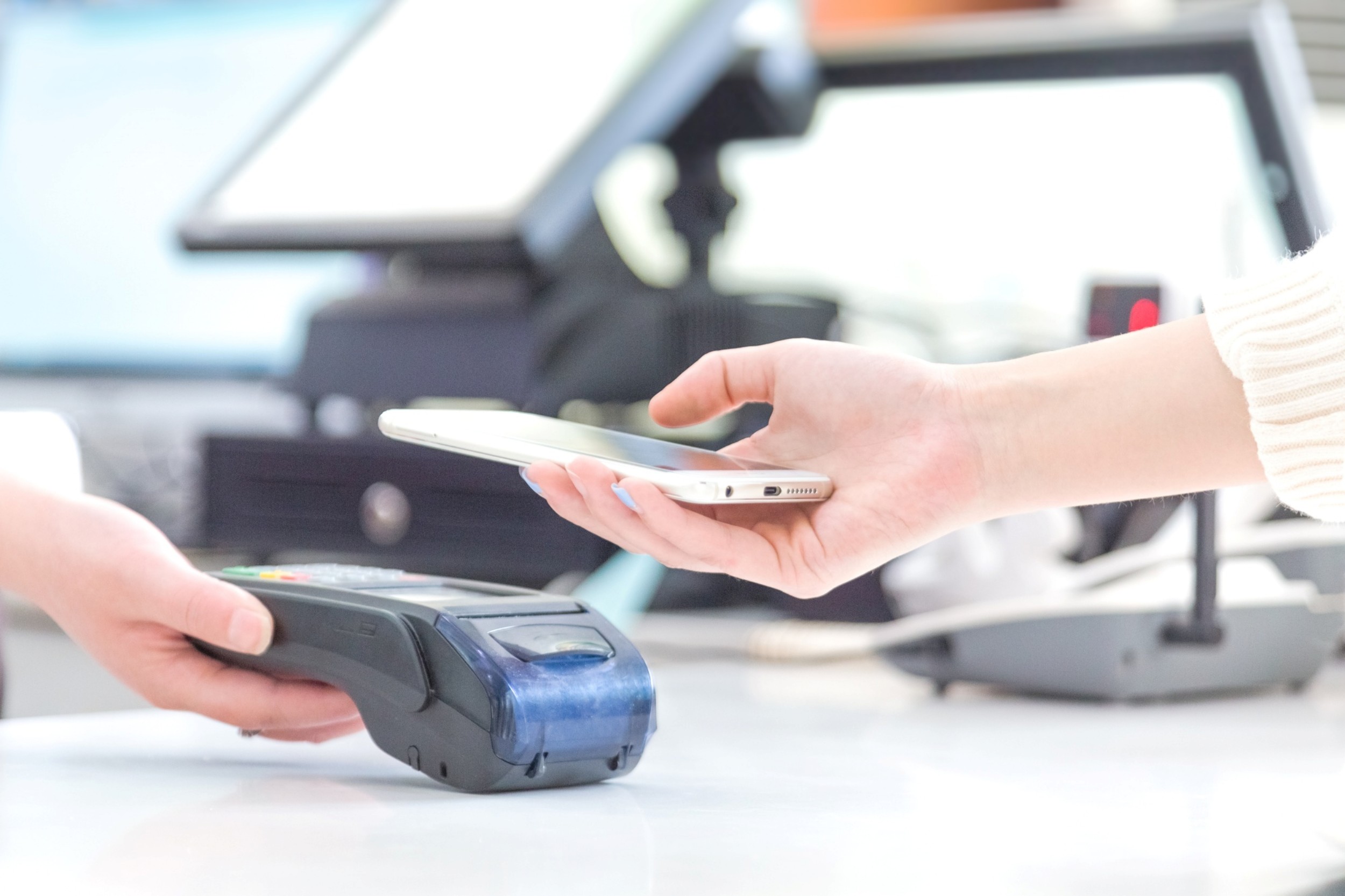
Mobile payment apps | Card acceptance, remote collection and online payments
A trusted payment platform for Visa, Mastercard, American Express and WeChat Pay on your phone, even when customers are away from your shop.
Supports: Visa · Mastercard · American Express · WeChat Pay (Hong Kong and mainland China)
Not every sale happens at a checkout. Salons collect treatment deposits, travel agents collect tour fees, furniture shops collect custom-order deposits and designers collect project payments. Customers are often elsewhere. mobile payment app turns your phone into a card-payment tool for in-person, remote and online transactions, removing time and location constraints.
Many industries can apply, including beauty, travel, furniture, design and jewellery. Higher-risk merchants may also apply, with possible instant-transfer options depending on the plan and approval. This offers a broad choice of payments to support your business. Our one-stop service can also compare merchant card terminal and Octopus payments plans for you.
- Express account opening
- Professional Hong Kong support for transaction enquiries
- Visa / Mastercard and WeChat Pay for Hong Kong and mainland users
- Instalments on cards from any bank, depending on the plan
- Remote collection supported
- Online customers can pay online
What is a mobile payment app?
It is a phone-based electronic payment solution. Merchants enter an amount or create a payment request in the app. Customers pay by card or wallet, and the platform settles the funds into the merchant's account.
Compared with a traditional Card payment terminals , its main difference is support for remote collection and online payments : customers can use a payment link or page without visiting. It offers more flexibility for appointment-based, made-to-order and online businesses than a terminal alone.
Six mobile payment app features
1. Card payments on your phone: Visa and Mastercard
Supports Visa, Mastercard and American Express, covering major Hong Kong card networks. Use the app as a mobile collection tool at exhibitions, customer premises or shops.
2. WeChat Pay for Hong Kong and mainland customers
Hong Kong and mainland WeChat Pay users can pay, including visitors, cross-border customers and local users. If you also need UnionPay and Alipay, compare Allinpay .
3. Remote collection
Collect deposits, booking fees, tour payments, custom-order deposits and balances without the customer being in-store. Taking payment beforehand can reduce cancellation and no-show losses.
4. Online payments
Online stores, social media sellers and online registration services can take payments online. The same platform handles online and offline collections for easier reconciliation.
5. Card instalments, depending on the plan
Some plans support instalments on cards from any bank, spreading larger purchases and helping sales of furniture, jewellery, beauty packages and courses. Instalment periods, fees and eligibility depend on the plan.
6. Hong Kong customer service and reconciliation support
A professional Hong Kong team answers transaction and settlement queries in Cantonese, avoiding the need to deal with overseas support.
Industries and use cases
| Industry | Typical collection scenario | Useful features |
|---|---|---|
| Beauty salons and aesthetic clinics | Treatment packages and booking deposits | Remote payments and card instalments |
| Travel agents | Tour fees, deposits and balances | Remote payments, online payments and WeChat Pay |
| Furniture and home products | Custom-order deposits and balances on delivery | Instalments and mobile collection at the customer's address |
| Design and renovation companies | Project deposits and milestone payments | Remote and online payments |
| Jewellery and watches | High-value products and visitor purchases | Card instalments and WeChat Pay |
| Education and courses | Tuition and registration fees | Online and remote payments |
| Online shops and social media sellers | Online orders | online payments |
If most payments are in-store and transaction volume is high, also compare bank card terminal applications ; restaurants and retail shops can combine payments with restaurant or retail POS systems .
Mobile payment apps vs traditional terminals vs smart POS terminals
| Comparison | mobile payment app | Traditional card terminal | Smart POS payment terminal |
|---|---|---|---|
| Collection device | Phone | Physical wired or wireless terminal | Android smart terminal |
| Remote and online payments | Supported | Usually unsupported | Depends on the plan |
| Must the customer be present? | No | Yes | Yes |
| Portability | Highest | Higher with wireless or mobile terminals | Medium to high |
| Suitable businesses | Appointments, custom orders and online sales | High-volume retail and restaurant checkout | Merchants wanting several payment methods on one device |
| Learn more | This page | Card terminal applications | Allinpay |
Many merchants combine tools: a card terminal in-store plus Octopus payments , with a mobile payment app for remote and online orders. For more on terminal types, see our terminal types comparison and Which card terminal provider? Six comparison points .
Clarify transaction fees, monthly charges and settlement
As with card terminals, a payment app's main cost is the Transaction fee (MDR) , calculated as a percentage of each sale. Before applying, ask:
- Rates by payment method: Are Visa, Mastercard, American Express and WeChat Pay charged differently?
- In-person vs remote transactions: Do card-not-present and in-person transactions have the same rate?
- Instalment fees: Does the merchant or customer pay? How much for each instalment term?
- Monthly and account-opening fees: Are there fixed charges or minimum transaction requirements?
- Settlement: When do funds arrive? Are instant transfers for higher-risk merchants charged separately?
- Refunds and chargebacks: How are refund and chargeback processing fees calculated?
For how transaction fees, monthly charges and rental affect costs, see the homepage's our complete card terminal charges guide .
*Actual rates and terms depend on platform approval and the contract.
Remote payment security: 3-D Secure, chargebacks and PCI DSS
Remote and online payments are card-not-present transactions. Without seeing the physical card, stolen-card risks are higher than for taps or chip payments. Reports in September 2026 described over 100 police reports involving stolen card details used for phone pre-orders, totalling about HK$4.6 million. Such incidents highlight the importance of remote payment security.
3-D Secure: additional authentication for online payments
3-D Secure (3DS) exchanges information between the merchant, issuing bank and cardholder to verify an online purchase. Network brands include Visa Secure, Mastercard Identity Check and American Express SafeKey. Cardholders may confirm through their bank app or enter a one-time password. Banks describe 3DS as additional protection, but merchants determine its use, so confirm that your payment page supports it.
How does a chargeback work?
- The cardholder disputes a transaction with the issuing bank.
- The issuer assesses whether the claim may be valid.
- The issuer informs the card network, and funds may be temporarily returned to the cardholder.
- The merchant responds with evidence such as orders, receipts, communications and delivery records.
PCI DSS card-data security standard
PCI DSS was established through the five founding members of the PCI Security Standards Council: Visa, Mastercard, American Express, Discover and JCB. When choosing a platform, confirm its PCI DSS certification to protect customers' card data.
Remote collection security checklist
- Do not collect full card numbers or security codes over WhatsApp, email or paper
- Use only payment links or pages supplied by the payment platform
- Verify identity and contact details for new customers making large orders
- Watch for repeated transactions on one card in a short time and unusual delivery addresses
- Keep orders, conversations, receipts and delivery proof for chargeback responses
- State refund and cancellation policies clearly to reduce disputes
Mobile payment app applications and documents
Application process
- Request a quotation: Tell us your industry, customers, average sale and whether payments are in person, remote or online.
- Recommend a plan: Recommend payment methods, instalment arrangements and settlement options.
- Prepare documents: We supply a checklist and help prepare application information.
- Submit for approval: The platform reviews business activities; higher-risk industries may need additional documents.
- Activate the service: After express approval, download the app, configure the account and start collecting.
Common document requirements
- Copy of a valid Business Registration Certificate (BR)
- Certificate of Incorporation (CI) for limited companies
- Identification for proprietors, directors or authorised persons
- Company bank-account details for settlement
- Business information such as shop photos, website, social media page or price list
*The payment platform determines document requirements.
FAQs: mobile payment apps
Which industries can apply?
Beauty salons, travel agents, furniture shops, designers, jewellers and general retail and service businesses can apply. Higher-risk industries may face extra approval and may have instant-transfer options, subject to the decision.
Are wallets such as WeChat Pay supported?
WeChat Pay supports Hong Kong and mainland users, and some plans also support remote collection. Describe your customers and payment settings when enquiring.
How is an app different from a card terminal?
A traditional terminal requires customers to insert or tap a card in person. An app uses a phone and also supports remote and online payments, so customers can pay without visiting. This suits bookings, deposits and online sales. For more comparisons, see Card terminal applications .
What is remote collection?
Customers pay without visiting, entering card details through a merchant-issued payment link or online payment page. Common uses include deposits, booking fees, custom products and online sales.
Are card instalments available?
Some plans support instalments on cards from any bank, useful for furniture, jewellery and beauty treatments. Terms determine instalment periods, fees and eligibility.
How can remote payments reduce stolen-card risks?
Card-not-present transactions carry higher risk. Use pages supporting 3DS, such as Visa Secure, Mastercard Identity Check or American Express SafeKey, so the issuing bank can verify the cardholder. Keep orders, communications and delivery records for disputes.
What is a chargeback?
A cardholder disputes a payment with the issuer, which may temporarily return funds after reviewing the claim. The merchant must provide evidence. Complete transaction records help resolve these cases.
Can higher-risk industries apply?
Some plans accept higher-risk merchants and may offer instant transfers, usually with extra review and documents. Explain your business so we can suggest suitable options.
How long does account opening take?
Express opening is offered; actual timing depends on the industry, document completeness and approval.
More questions? Contact us for a quotation or browse Card terminal and Octopus FAQs .
Want to compare app, terminal and Octopus fees? Leave your details for a prompt quotation.
Request a quote